by DharamCW | Jan 21, 2024 | Program Management
Program Portfolio Management Leadership | Justin Buckwalter | Dharam Singh | Episode 11
Dive into the nuances of leadership with Justin Buckwalter, PfMP, PgMP, PMP, PMI-ACP, PMI-RMP and myself in the latest episode of our webinar series. We’re unraveling the facets of effective Program Portfolio Management Leadership, a skill set that’s becoming increasingly vital in the contemporary business landscape.
This episode is packed with insights on:
1. The diverse leadership styles that shape impactful leaders.
2. Emotional intelligence as a cornerstone for modern leadership.
3. Strategies for guiding teams through crises and organizational turbulence.
4. The dance between nurturing leadership and handling workplace politics.
5. Crafting meetings that matter with focused agendas and clear objectives.
Join us to understand why leadership in project management is more about EQ than IQ and how to foster strong team relations amidst complex challenges. Get ready to elevate your leadership approach for today’s dynamic world.
🎯 For Project Management professionals eager to elevate their careers, seize this chance:
– FREE webinar series on CAPM & PMP certifications: https://bit.ly/42iE5rJ
– Book an obligation-free 15-minute session with me: http://bit.ly/2SbhTOK
– Stay updated with our Q&A series and certification success stories by subscribing to the vCare Project Management YouTube channel at https://bit.ly/2YF0wJl
– Follow my podcasts and interviews with Project Management Experts on YouTube at https://bit.ly/2NDY8wd
– Avail Exclusive offers on our website: https://bit.ly/3jWVepD
by DharamCW | Jan 7, 2024 | Program Management
Letter to Future Program Portfolio Manager | Justin Buckwalter | Dharam Singh | Episode 10
In our latest webinar episode, Justin Buckwalter joins me to delve into the future of program and portfolio management. As the business world rapidly evolves, professionals in our field need to stay ahead of the curve. This episode, “Letter to Future Program Portfolio Manager,” is a must-watch for those aspiring to shape the future of this dynamic industry.
We discuss vital topics for the future of program/portfolio management, including:
– The evolving landscape of program/portfolio management in 2023 and beyond.
– Challenges faced by C-Suite executives and board members in adapting to change.
– The increasing importance of professional judgment over intuition in decision-making.
– Key competencies and skills will be crucial for future program/portfolio managers.
– Navigating disruptions and the digital transformation in program/portfolio management.
– The significance of training and development for insightful, balanced, and innovative management.
– The role of shared innovation in fostering long-term global client relationships.
– Debating the reality of future-proofing projects, programs, and portfolios.
👀 Discover insightful perspectives on preparing for the future in program and portfolio management. Watch now: https://youtu.be/yOeUdSaRs2M
Join the conversation and share your thoughts on these forward-thinking topics.
🎯 For Project Management professionals eager to elevate their careers, seize this chance:
– FREE webinar series registration on PgMP® & PfMP®: https://bit.ly/3Z7kzMl
– Book an obligation-free 15-minute session with me: http://bit.ly/2SbhTOK
– Stay updated with our Q&A series and certification success stories by subscribing to the vCare Project Management YouTube channel at https://bit.ly/2YF0wJl
– Follow my podcasts and interviews with Project Management Experts on YouTube at https://bit.ly/2NDY8wd
– Avail Exclusive offers on our website: https://bit.ly/3jWVepD
by DharamCW | Jan 5, 2024 | Leadership in Project Management
🌟 Unveiling the Qualities of Exceptional Situational Leaders 🌟
Situational leadership stands out as a cornerstone for success in the dynamic realm of project, program, and portfolio management. Today, I want to spotlight the essential qualities that define great situational leaders. These traits are not just about leading; they’re about elevating your team to its highest potential.
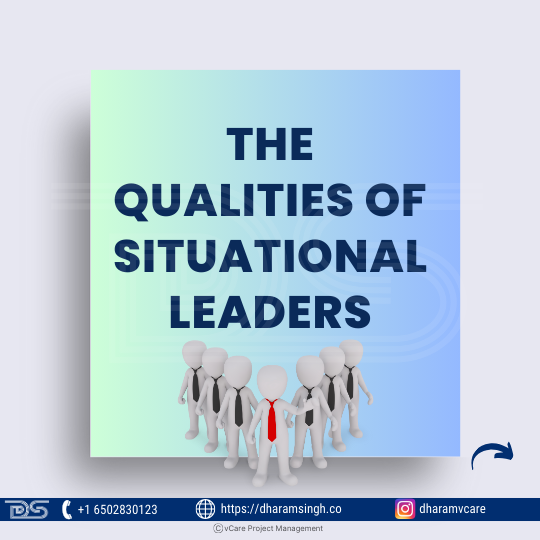
Qualities of Situational Leaders
A situational leader is someone who:
1. Exhibits Flexibility: Adapts their leadership style to the evolving growth levels of each team member.
Flexibility
2. Builds Trustworthiness: Gains the trust of their team, fostering an environment of reliability and confidence.
Trustworthiness
3. Masters Delegation: Knows when and how to delegate tasks effectively to highly competent and committed team members.

Delegation
4. Hones Coaching Skills: Guides those lacking confidence or ability, ensuring everyone’s on the right path.
Coaching Skills
5. Shows Courage: Isn’t afraid to change their leadership approach, especially when traditional methods no longer serve the team’s needs.
Courage
These situational leadership qualities drive project success and nurture a culture of growth and adaptability. Understanding and developing these traits can be a game-changer in your leadership journey.
🔗 Stay tuned for more insights into the art of effective leadership in project management.
Follow Me On,
Linkedin – https://bit.ly/3jJ0zeS
Facebook – https://bit.ly/3jQRTmV
Instagram – https://bit.ly/3h6xzMB
Twitter – http://bit.ly/3zB4Qv0
Pinterest – http://bit.ly/40H4Fdu
YouTube – https://bit.ly/2NDY8wd
Dharam Singh Social Media
🚀 Elevate Your Project Management Career:
– Please register for my FREE webinar series on PgMP® and PfMP® certifications: https://bit.ly/3Z7kzMl
– Discover training offers and certification discounts: https://bit.ly/3jWVepD
– Book an obligation-free consultation session on PM Career, training, and certifications: http://bit.ly/2SbhTOK
– Stay updated: Subscribe to our YouTube Channels for more insights: https://bit.ly/2YF0wJl and expert interviews: https://bit.ly/2NDY8wd
by admin | Oct 13, 2023 | General
Organizations may stay profitable and competitive using project management practices that help identify process improvements or cost-cutting opportunities. Metrics may assist in discovering areas for improvement, data to focus on, and how to quantify the success and efficacy of a company’s efforts. Knowing more about project management metrics that can assess performance will help one acquire professional skills for any business and advance their career in project management.
Every organization needs to ask,
- “Are we getting the outcomes we want?”
- “Are we accomplishing our project objectives?”
- “Are we meeting the requirements for customer success?”
- “Are we getting the intended return on investment?”
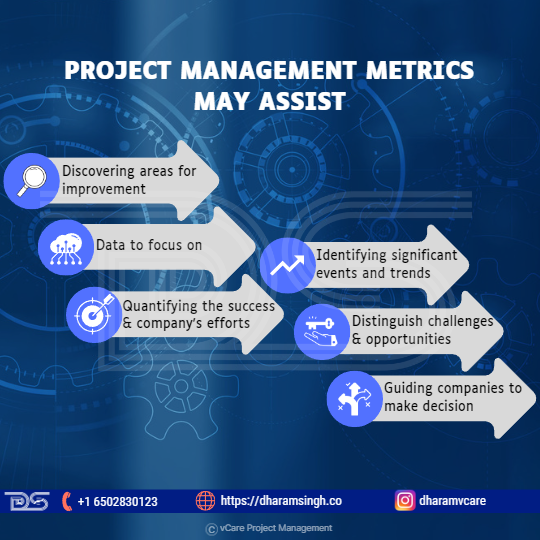
Project Management Metrics May Assist
Success depends on the ability to forecast and meet product and service commitments. With projects becoming more common, it is critical to show additional value to the business using project management strategies, tools, and procedures. Therefore, a metrics program is required. Metrics may assist in identifying significant events and trends, distinguishing between challenges and opportunities, and guiding companies to make wise decisions.
How can we know whether the project management efforts make a difference and contribute to corporate success?
- It has long been known that suitable measuring methods are essential to basic management tasks, including project planning, monitoring, and control, and metrics are present at all stages of project management.
- As project management grows prominence and more firms embrace a project-based management approach, objective and performance-based management highly depend on measurement processes.
- To assist decision-making, project selection, portfolio management, and lead product and process improvement, metrics must be integrated into project life-cycle activities.
- In addition, metrics may be used to assess an organization’s project management maturity.
- Metrics aid in understanding capacities, allowing for developing strategies based on creating and delivering goods and services. They also enable people to recognize significant events and patterns and distinguish between challenges and opportunities.
- Metrics can assist in improved cost and schedule management, decrease risks, increase quality, and guarantee that objectives are met.
Measuring is an end goal in some businesses. Individuals in such businesses who have obtained project management certification and use specific project management tools and processes are the ones who often recognize the significance of project management. At the same time, individuals at the top may only accept this value partially. A metrics practice put in place is one of the best methods for successfully explaining the benefits of project management to top executives.
What are Project Management Metrics
What are Project Management Metrics?
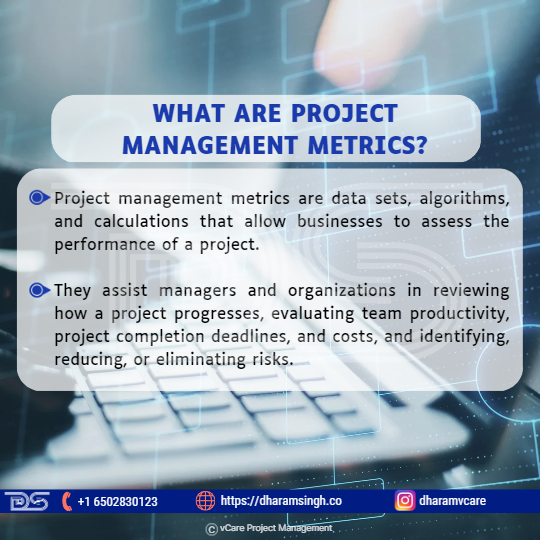
Project management metrics are data sets, algorithms, and calculations that allow businesses to assess the performance of a project. They assist managers and organizations in reviewing how a project progresses, evaluating team productivity, project completion deadlines, and costs, and identifying, reducing, or eliminating risks. Project management metrics are numerical instruments that firms use to build successful strategies, carry out continuous improvement initiatives, and assess employee and customer sentiment.
Benefits of using metrics in project management
Project management metrics are an efficient approach to assessing a project’s progress. Measuring the project’s performance against key parameters helps to understand the management process. These indicators in project management also assist in steering project objectives, allowing teams to assess success and make improvements as needed.
Following and evaluating the right indications can provide the company with critical insights regarding the team’s performance – from both a high-level and individual standpoint. In addition, you’ll be able to identify process bottlenecks and other inefficiencies, which one can subsequently fix, adding to the project assumptions list and enhancing future project performance.
Furthermore, tracking and collecting this sort of data might be useful when the time comes for the project management performance review. Taking responsibility for the team’s work by analyzing project outcomes, identifying inefficiencies, and developing improvement plans sends a strong message to management. It displays that one can be a real leader committed to the business’s success.
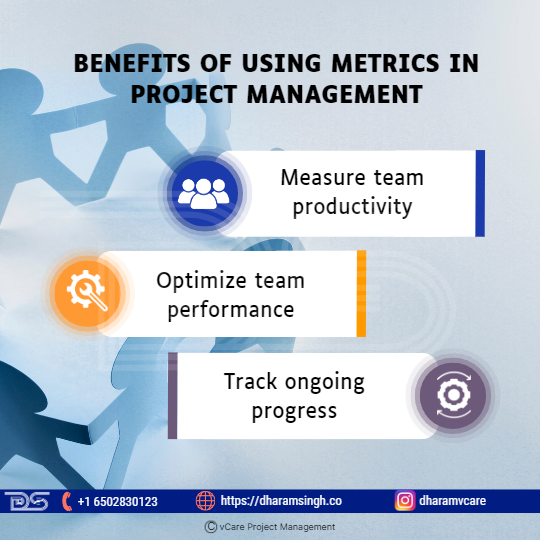
Benefits of Using Metrics in Project Management
- Measure team productivity
Relevant metrics in project management can reflect a team’s productivity. For example, the on-time delivery (OTD) rate or service level agreement (SLA) rate might be used to calculate the project’s ROI.
- Optimize team performance
While it is critical to maintain the team’s performance, forward-thinking management seeks development opportunities. Relevant project metrics enable one to broaden their understanding of project-related aspects. Project performance measurement reduces uncertainty and allows individuals to make better, more informed decisions.
- Track ongoing progress
Management performance metrics also track a project’s progress over time. These metrics are critical to discover obstacles early and help adjust the track as needed.
Project Management Metrics: How to Measure and Track Success
Relevant project management metrics will help enhance our understanding by eliminating uncertainty and making well-informed decisions.
Metrics prove value
Cost-related project management indicators may demonstrate the value of a team—for example, a rate of on-time delivery or a rate of satisfying SLA. Return on Investment (ROI) is a popular statistic for demonstrating this value. If a department fails to generate or contribute to a firm’s measurable objectives, a smart business would dissolve the department and redirect resources to another area that provides results.
How to choose the Metrics
Metrics improve performance
While demonstrating value is crucial, forward-thinking management prioritizes performance improvement. Relevant metrics help you have a better grasp of project management. This aspect reduces ambiguity, allowing all parties involved to make informed decisions. For example, assume that the given slack time is causing the completion of the following task to be delayed. You can adjust the slack time to keep the project deadline.
How to choose the metrics?
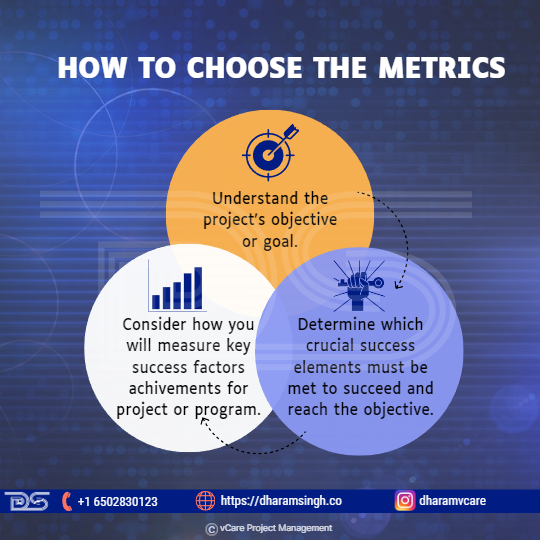
Each business or project requires metrics specific to its purpose or aim. Metrics are determined in three steps:
- Understand the project’s objective or goal.
- Determine which crucial success elements must be met to succeed and reach the objective.
- Consider how you will measure the achievement of each key success factor for the project or program.
What makes a successful project?
What makes a successful project?
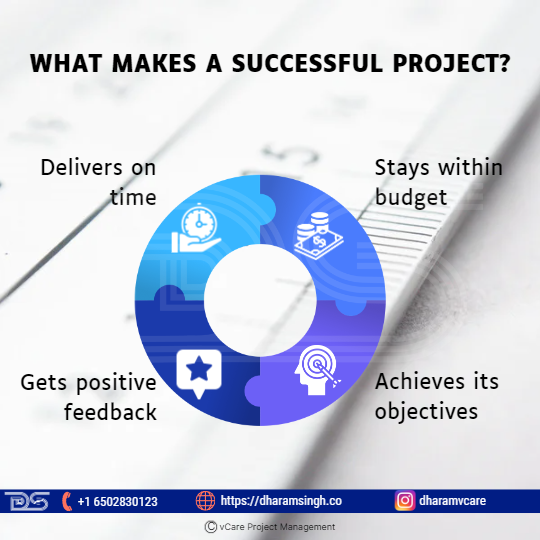
Before starting any project, you and your team should know what constitutes a successful project. After all, you want to avoid being known for a famous failed project. So what makes a project successful? First, you should establish a set of success criteria for your project, including the following:
- Delivers on time: Completing a project on schedule and under budget is one measure of success, especially for external parties, such as clients.
- Stays within budget: A budget is in place for all initiatives. You will have succeeded if you can finish yours without incurring more fees and expenses.
- Achieves its objectives: If your project was completed and met its objectives — as stated at the outset — that’s a huge accomplishment.
- Gets positive feedback: Assessing a project’s internal and external success is simple. But how did it fare? If stakeholders and clients offer positive feedback, the project will be considered a success.
Key Project management metrics
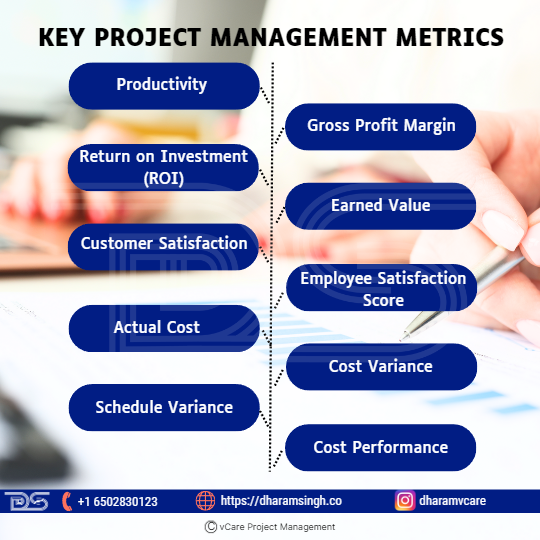
Project management metrics may be established based on the purpose and complexity of the project. However, the ten key project metrics listed below often cover the most important measurements:
Key Project management metrics
- Productivity
This indicator examines a company’s total skills — how well it uses its resources. Productivity demonstrates the connection between inputs and outcomes. For example, how much do you get out of a project after your efforts? The optimal productivity outcome is to produce more with less.
Productivity = Units of Input/Units of Output
- Gross Profit Margin
Numbers are more powerful than words. Indicators directly related to the bottom line indicate success or failure faster than other metrics.
The larger the profit margin, the better the business. Any program or effort done should add to a company’s financial profit. The margin is the proportion of each dollar generated after expenses are deducted.
Gross Profit Margin = (Total Profit-Total Costs)/100
- Return on Investment (ROI)
Return on investment especially considers the dollar amount earned for the amount spent on a project. This metric is a financial calculation similar to gross margin. However, instead of focusing on a total profit, it considers the specific benefit of the project divided by the costs.
To use this metric, a dollar value must be assigned to each unit of data to calculate the net benefits, which may include:
- Contribution to profit
- Cost savings
- Increased output
Costs may include resources, labor, training, and overhead.
ROI = (Net Benefits/Costs) x 100
- Earned Value
Earned value provides strategic guidance by displaying how much you have derived from the money invested in a project to date. It compares the value of work performed by a given date to the project’s approved budget.
Earned value is often called the Budgeted Cost of Work Performed (BCWP). This statistic serves as a reality check during the project’s execution.
Earned Value (EV) = % of Completed Work / Budget at Completion (BAC)
- Customer Satisfaction
A customer satisfaction score is a quality indicator for your service or product—the findings of a customer survey influence this metric. In addition, the product or service should perform as intended and meet genuine client demands.
Each organization may create a unique score by weighing each component depending on its value. Customer survey results, money earned from clients, repeat or lost clients, and complaints are examples of variables.
The Customer Satisfaction Index (CSI) is the most extensively used metric for customer satisfaction. Another technique for measuring customer satisfaction is the Net Promoter Score (NPS). NPS measures customer loyalty by determining the chance of a consumer suggesting a product or service.
Customer Satisfaction Score = (Total Survey Point Score / Total Questions) x 100
- Employee Satisfaction Score
Survey data determines employee satisfaction in the same way that customer satisfaction is. So why should workers be included while evaluating project management? The answer is straightforward: employee morale is directly related to project performance.
In the end, a satisfied employee does better work and more efficiently. In addition, the high costs of employee turnover for a firm — which may range from 50% to 200% of an employee’s salary — should be motivation enough to focus on the people closest to the project.
The Gallup Q12 Employee Engagement Survey is a well-known data collection tool. An ESI procedure yields an index score.
Employee Satisfaction Score = (Total Survey Point Score / Total Questions) x 100
- Actual Cost
The Actual cost is a simple statistic that displays how much money is spent on a project rather than simply an estimate. This cost is calculated by adding all the expenses for a specific project across the timeline.
Actual Cost (AC) = Total Costs per Time Period x Time Period
- Cost Variance
Cost variance describes the difference between the intended budget and actual expenses during a given time period. Is the estimate higher or lower than the actual costs?
- A project is over budgetif the cost variance is negative.
- A project is under budgetif the cost variance is positive(a standard measure of success).
Cost Variance (CV) = Budgeted Cost of Work – Actual Cost of Work
- Schedule Variance
The schedule variance examines both budgeted and scheduled work. Is the project running ahead of or behind schedule?
The schedule variance is the difference between work scheduled and work accomplished, calculated as the budgeted cost of work executed minus the budgeted cost of work scheduled. A negative schedule variance indicates that the project is running late.
Schedule Variance (SV) = Budgeted Cost of Work Performed – Budgeted Cost of Work Scheduled
- Cost Performance
Cost performance is a cost efficiency metric. Divide the value of the work performed (earned value) by the actual costs incurred to get the earned value. Forecasting cost performance provides for more precise budget estimates.
Cost Performance Index (CPI) = Earned Value / Actual Costs
Implementing Project Metrics
Once project metrics have been established to meet the company’s goals, it’s time to apply them. First, interact with users to help them understand the process, its value, and how analytics may enhance projects. Then, provide specific examples, such as “the dashboard will indicate where we need documentation, so we may prevent delays by gathering the necessary information.”
Create a project management metrics strategy with criteria everyone can understand to help you get support. Explain the significant indicators you’ll be measuring, how you’ll track them, and the goals you intend to achieve. The strategy should then be put into action. Understand that project metrics should lead to action; else, they are worthless. As you discover unusable metrics, revise the plan.
Final Thoughts
Project management metrics are critical to the success of any organization. They track the progress of initiatives, assist managers in defining success, and verify that the team is heading in the right direction.
It is complicated to analyze and evaluate a project’s development without appropriate metrics in project management. With precise, trackable KPIs, the company can assess project progress and identify when it’s time to change strategy or where the team is experiencing difficulty. If the company does not make the essential changes, it may face serious obstacles and lead to failure. As a result, measuring important project management metrics is vital to the company’s success.
Feel free to check out my discussion on this topic with Justin Buckwalter in YouTube
Register today for my FREE webinar series on PgMP® and PfMP® certifications! Don’t miss out on this opportunity to advance your project management career. Click the registration link to sign up: https://bit.ly/3Z7kzMl
Are you looking for project management training and certification discounts? Check out our various offers and discounts here: https://bit.ly/3jWVepD
Have questions about your project management career, training, and certifications? Book an obligation-free 15-minute session with me and get the answers you need: http://bit.ly/2SbhTOK
Stay up to date on the latest in project management by subscribing to the vCare Project Management YouTube Channel. Catch our Q&A series and certification success stories here: https://bit.ly/2YF0wJl
Want to hear from project management experts? Subscribe and follow my podcasts and interviews on YouTube here: https://bit.ly/2NDY8wd
by DharamCW | Apr 21, 2023 | General
What makes a successful Project/Program/Portfolio Manager? Is it the number of years of experience? Technical know-how? Or the one who is good at managing people?
Creating objectives, critical path analysis, work breakdown structures, resource scheduling, and risk management are just a few of the technical areas of project management that project managers usually get training in. However, understanding pertinent people and management issues is important to a project’s success. In addition, a project manager must also continually deal with clients and other stakeholders. As a result, project managers’ people skills, also known as soft skills, are becoming increasingly important.
People Skills
People skills
People skills are linked with behavioral patterns or behavioral interactions that assist one in communicating effectively with people. Project leaders with strong people skills may favorably influence others, socialize effortlessly, and overcome public anxiety.
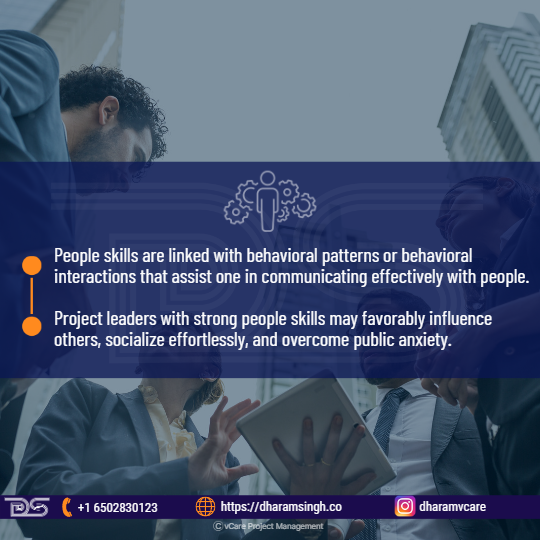
Project Leaders With Strong People Skills
They are transferrable social abilities that allow one to collaborate well with others. The three main types are personal, interaction, and interpersonal skills. These categories achieve the same overall objective: making the working connections with others mutually satisfying, pleasant, and productive.
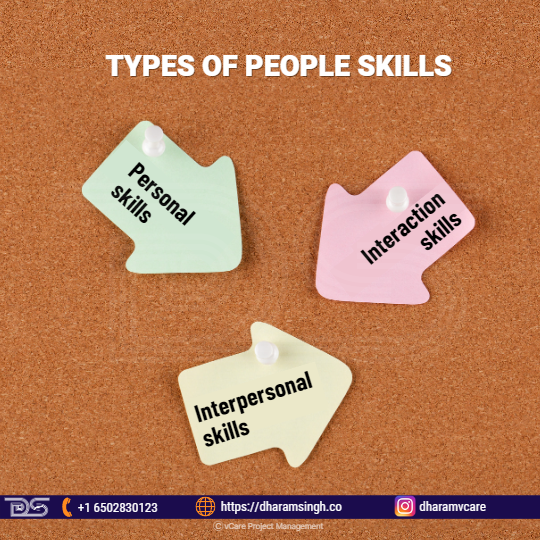
Types Of People Skills
Types of People Skills
- Personal skills: These include the capacity to communicate your skills and exhibit yourself to others successfully. It comprises characteristics such as self-assurance, honesty, and aggressiveness. Furthermore, one must be able to recognize their limitations and make sound judgments based on logic rather than emotion.
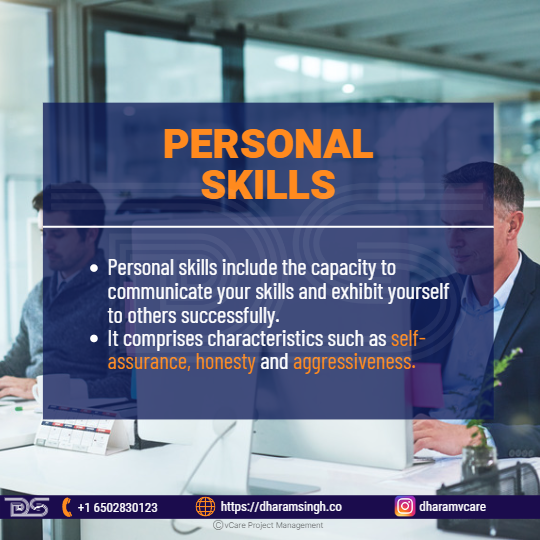
Personal Skills
- Interaction skills: It is essential for understanding the behavior and ideas of others while preserving limits and creating connections. A project manager, for example, should have social etiquettes that need empathy and listening skills to know that you have listened to them and given respect for their limits and requirements to connect with co-workers and clients productively.
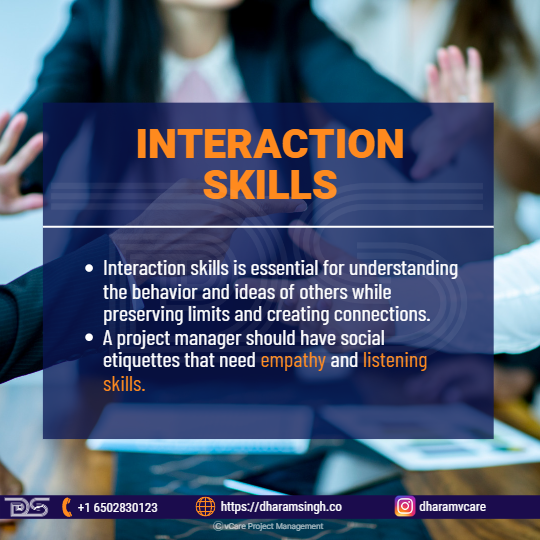
Interaction Skills
- Interpersonal skills: These are related to intercession skills, but they apply mainly to situations in which the persons involved have opposing interests or viewpoints.
Contrary to popular belief, people skills are not subjective concepts. On the contrary, these skills are critical, particularly in the project management role, which is largely concerned with people.
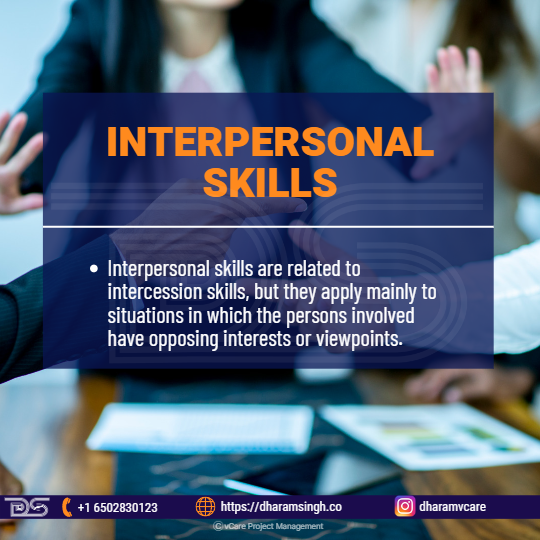
Interpersonal Skills
Project management is more than just completing the project; it is also about how you lead and assist your team. Leading others and leading them through the whole project lifecycle entails a certain amount of responsibility and necessitates certain abilities.
Furthermore, as work evolves, businesses embrace a varied workforce. As a result, people skills are essential for embracing tolerance and diversity. In short, good project management is based on human communication and connection.
Essential People Skills for Project/Program/Portfolio Managers
A successful project professional must possess a wide range of skills. Those that come to mind first are the technical skills required to create a project plan, schedule, budget, and all relevant paperwork. One must also have the conceptual skills to “see” the project as it develops.
However, such talents will only assure project success if the project manager can supplement their technical skills with a wide range of interpersonal skills or people skills. Here are some of the essential people skills for Project/Program/Portfolio Managers:
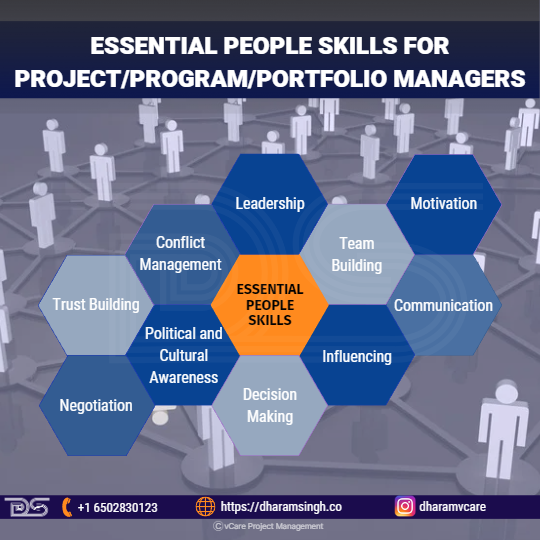
Essential People Skills for Project/Program/Portfolio Managers
- Leadership
One of the crucial skills a successful project manager has to have is leadership. This skill is essential because the project manager frequently has little control over the team members involved. This aspect calls for leadership on their part to handle the project. Although managing via leadership rather than authority might be more challenging, it is typically more effective since it is based on respect and trust.
At the start of a project, a leader must establish their vision and express it to the team. It makes supporting the project’s objectives easier for everyone on the team. Effective leadership will also keep the team members inspired and motivated to perform at their highest level.
- Team Building
Another vital skill for a competent project manager is team building. Because of the nature of projects, personnel from diverse departments are engaged. Most employees might have never worked together and may not even be familiar with one other’s departments. If the project manager can unite these individuals into a cohesive team with the same goal, the project may stay within its objectives.
Although some of the project’s individuals or sub-teams may execute their jobs individually, they must feel like they are part of the overall team. When choosing their part of the project, they must consider what is best for the project, not simply what is best for them and their departmental problem. A sense of belonging to a team that solves an issue for the entire company (rather than playing departmental favoritism) may go a long way.
Creating a team in which each member feels comfortable reaching out to the others will also guarantee that minor problems do not escalate into major concerns later in the project. It is consequently critical that project managers not only understand the duties and procedures involved in team building but also have the skill and finesse to apply them correctly.
- Motivation
If you want your project to succeed, you should concentrate on improving your motivating skills. Having these qualities will assist your project team members to stay interested in the project, strive for excellence, and work toward a common objective.
Good motivating skills will enable a project leader to create an environment where team members can fulfill project objectives while being satisfied with their work.
- Communication
Most professions require excellent communication skills. Some project managers believe the communication part of project management to be their primary job obligation.
Excellent communication skills are essential for building relationships among project team members, establishing trust, and keeping everyone motivated and on track.
A project involves several stakeholders informed of its status, timeframes, progress, risks, and concerns. A skilled project leader must convey all of these facts to project stakeholders on time and in the manner they anticipate. Project managers must also interact effectively with top management within their business.
Giving the interested stakeholders too much or not enough information might prevent the project from reaching its full potential.
- Influencing
It is critical to be able to influence people if you want to be a successful project manager. But what is important is understanding when and how to utilize such skills and avoid becoming a manipulator. There is a narrow path to follow.
A project manager’s responsibility is to bring employees from disparate departments together and get them to work together toward a similar objective. Sometimes, getting these diverse people to comprehend and agree on the specifics of achieving that goal might not be easy. A skilled project leader will utilize their skills to persuade others and assist them in reaching an agreement.
So, think about your relationship and influence over people not just for the time of the project but also for how things will proceed long after the project is complete. After the project, customers and end-users will utilize the goods, deliverables, and outcomes developed by the project. A powerful and positive effect creates a trusting atmosphere among all team members during and even after the project.
- Decision Making
A successful project manager must acquire various talents, one of which is decision-making skills. There are four primary decision-making styles: Directive, Analytical, Conceptual, and Behavioral. Project managers should be conversant with all four since either has to be leveraged at some time. In addition, consultation, consensus, command, and random styles are provided.
Having a decision-making model will facilitate this process. In addition, since so many people who may disagree with a decision are involved in the project, having a process to follow can be very helpful in gaining consensus with the group.
- Political and Cultural Awareness
In today’s world, project managers work in a more globalized context than in the past. As a result, cultural diversity is another critical component of effectively navigating the corporate world as a project leader. A successful project manager must be able to notice and comprehend cultural differences and incorporate them into the project plan.
Cultural differences can impact decision-making and the pace with which work is performed. It can also lead to members acting without sufficient forethought. Recognizing cultural differences can lead to conflict and stress within the project, further delaying it.
Furthermore, it is critical to understand the politics at work in the project environment. The use of political skills can greatly aid a project manager’s success. More significantly, failing to recognize the politics involved can lead to substantial challenges and impediments that can cause a project to be delayed or even destroyed.
- Negotiation
The nature of a project manager’s work necessitates being skilled negotiators. Typically, several stakeholders are involved in the project, and most projects include team members from many departments. This aspect frequently leads to a variety of points of view, which can make it challenging to keep the project on track and within the intended scope.
Negotiation skills can assist a project manager in obtaining an agreement or making a compromise on an issue that may be causing difficulty or delay.
There are several negotiation skills that the project leader should be able to employ. These include assessing each scenario, being an engaged listener, and communicating coherently throughout the dialogue. It can be important to distinguish between the wants and requirements of the people concerned. Another critical focus is recognizing the distinction between people’s perspectives and their interests and concerns directly relevant to the project.
- Trust Building
When collaborating on a project, trust is really valuable. A trusting environment promotes effective relationships and communication among team members and stakeholders. Therefore, a project leader wants to foster an atmosphere of mutual trust. This trust helps to maintain morale, keep conflict at a minimum, and keep everyone working effectively together.
If you were working on a project, you would want everyone participating and working hard to see it through to completion. When you work hard, you expect that others are also working hard to achieve the project objectives. The team leader wants to trust a team member who suggests they can execute a task properly and on time. If someone in the team wants assistance, they want a team that will support and collaborate to achieve the work. So don’t waste time second-guessing someone who isn’t telling the truth or has bad motives.
There are several approaches for a project manager to establish trust. First, a project leader must be a great and open communicator to reduce misunderstandings and build confidence among team members. Often, one may have to put their self-interests aside for the team’s sake and must model and display the behavior they demand from others.
- Conflict Management
On a project, conflict is almost unavoidable. Members of the project team and stakeholders may have differing perspectives, areas of expertise, interests, personalities, work styles, and so on. When one adds additional factors to the mix, such as tight deadlines, resource limits, and communication challenges, it’s easy to understand how conflict might arise.
Conflict often leads to a better solution to a problem. For example, if a team member would prefer to agree or accept the status quo, then risk causing conflict by pointing out a problem, asking a question, or suggesting an improvement. In that case, it is simpler to accept a suboptimal solution. However, disagreement frequently stops the team from working successfully together and diverts attention away from the duties at hand.
The goal is to prevent conflict or its escalation or to know how to regulate or lessen it when it arises if they cannot avoid it. For example, a project manager may use several tactics or methods when dealing with a dispute. They can be aggressive, accommodating, avoiding, or compromising. Some approaches work better in particular situations than others.
The project manager and team members involved in the conflict influence the team’s efficacy. A project manager can also utilize many approaches; if one fails, they may have to try another to see if it is more successful.
Why are people skills important?
People skills are crucial because it is much more difficult for people in an organization to work together to achieve common goals if they fail to express themselves or understand how their co-workers feel about a certain project, task, or difficulty.
As a result, the organization’s production and profitability suffer while creativity and innovation endure. People skills, in particular, may assist us in the following:
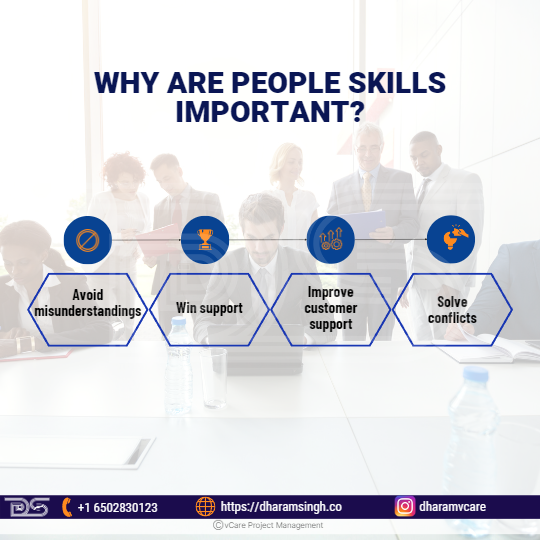
Why Are People Skills Important?
- Avoid misunderstandings: People are less likely to misinterpret what you’re saying if you communicate ideas and instructions.
- Win support: If you can communicate effectively and understand what your team wants to hear, it will be much simpler to persuade them and get them “on board.”
- Improve customer support: You’ll be better positioned to fix their difficulties if you can get inside their minds and comprehend their key problems.
- Solve conflicts: Conflict isn’t always unpleasant, but if it goes unresolved, it can harm morale and productivity. Strong people skills allow us to see things from a new perspective and identify similarities, which reduces the likelihood of significant conflicts.
How to develop people skills?
Even while people skills are critical, they are frequently undervalued by employers when it comes to job advancement. Internal training sessions are frequently centered on teaching hard skills, such as completing a given activity or utilizing a specific piece of software. These methods make it more difficult for professionals to build their interpersonal skills.
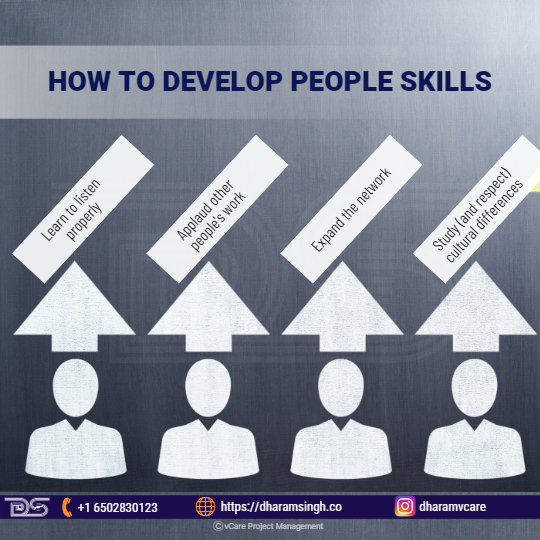
How To Develop People Skills?
But just because something is more difficult does not make it impossible. Here are four suggestions for improving people skills and becoming a more attractive prospect are:
- Learn to listen properly
- Applaud other people’s work
- Expand the network
- Study (and respect) cultural differences
Final Thoughts
Effective project management is challenging but having people skills may help project leaders run projects more efficiently and with less stress. Furthermore, it enables building a team that can handle the most challenging tasks and is more successful and resilient during difficult times.
People skills, on their own, will not keep a project team motivated and engaged. However, arming oneself with the necessary technical skills and intelligent tools may dramatically enhance the workflow and contribute to the project’s success.
Feel free to check out my discussion on this topic with Thomas Walenta in YouTube
For any questions related to your Project Management career, training, and certifications, you can book an obligation free 15 minutes session with me by visiting http://talktodharam.com/
You can subscribe to the vCare Project Management YouTube Channel to catch future videos of our Q&A series and certification success stories: https://bit.ly/2YF0wJl
You can subscribe to and follow my podcasts and interviews with Project Management Experts on YouTube at https://bit.ly/2NDY8wd



Recent Comments